Showing posts with label Deepwater Horizon. Show all posts

Sunday, October 3, 2010

"Responder" completes mission

Captains,
It's good to see the work horses of the nation's inventory of high-capacity offshore oil recovery returning to their home ports. Marine Spill Response Corporation operates 15 "Responder" class OSRVs, 210 ft special built vessels with oil-water separator systems. Most were deployed to the Gulf of Mexico for several months and collectively were the most effective offshore oil recovery asset.
This picture of the Maine Responder and the CGC Shackle was actually taken last winter during the Spill of National Significance (SONS) exercise conducted in Portland Maine. Little did we know at that time there would be a real SONS within weeks.
RADM W

September 30

Maine Responder returns to Portland today

PORTLAND — A 208-foot oil-spill cleanup vessel is arriving in Maine after spending nearly five months working on the Gulf of Mexico oil spill.

The Coast Guard says the Maine Responder is scheduled to arrive in port this morning.

The vessel is owned by the Marine Spill Response Corp. and kept on the Portland waterfront.

It usually responds to oil spills in the Northeast, but was sent to the Gulf in May. The vessel has thousands of feet of booms to contain and absorb spills and equipment to remove it from the water.

Sunday, August 8, 2010

What happened to the oil?

Captains,
I posted comments on the fate of the spilled oil from Deepwater Horizon disaster back on July 16th. This week the US Government posted an official report. According to this report, the Unified Command's response operations mitigated about 1/3 of the 4.9 million barrels. This is actually a pretty good measure. Often, spill response efforts manage to mitigate less than 1/10 barrels spilled.
Of the remaining 2/3, note that over 40% evaporates, dissolves like sugar, or naturally disperses into microscopic droplets that get consumed by micro-organisms. This percentage is very typical for any oil spill. So it's the 25% residual amount that response operations hoped to minimize.
Fortunately, the Deepwater Horizon residual sweet Louisiana crude oil is 1. buoyant, 2. far from shore, and 3. in warm water. These three factors greatly assist natural degradation, which will actually be the fate of the recovered oil and oiled debris when it's deposited into the land fills of the four affected states.
RADM W

Deepwater Horizon Oil Budget

Flow Rate: The Oil Budget Calculator starts with an estimate of the cumulative amount of oil released

over the course of the spill. The newest estimates reflect the collaborative work and discussions of the

National Incident Command’s Flow Rate Technical Group (FRTG) led by United States Geological

Survey (USGS) Director Marcia McNutt, and a team of Department of Energy (DOE) scientists and

engineers, led by Energy Secretary Steven Chu. This group estimates that approximately 4.9 million

barrels of oil flowed from the BP Deepwater Horizon wellhead between April 22 and July 15, 2010, at

which time the flow of oil was suspended. The uncertainty of this estimate is + 10%. The pie chart

above is based on this group’s estimate of 4.9 million barrels of oil.


Saturday, July 17, 2010

Extraordinary Response for DWH oil spill


Captains,

Operating a fleet of 6,800 vessels and barges operating to recover 33 million gallons of mixed emulsified oil and 387 controlled burns which have removed another 11 million gallons of oil over the last 87 days are just part of the extraordinary Deepwater Horizon spill response. Novel concepts like giant sand berms and a tanker-skimmer were also tested.
RADM W

Photos tell different stories about sand berm effort to block Gulf of Mexico oil spill

Published: Wednesday, July 14, 2010, 6:15 PM Updated: Wednesday, July 14, 2010, 9:16 PM

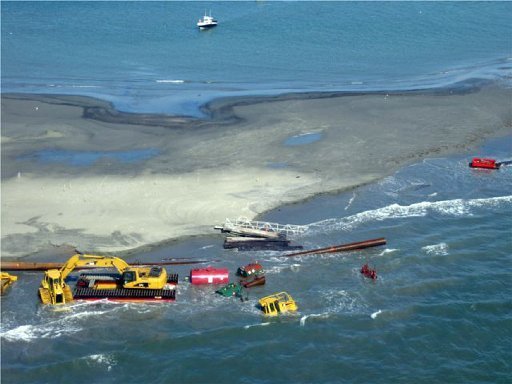
Critics and supporters of building sand berms to shield Louisiana's coast from the Gulf of Mexico oil spill have released dueling photo sequences that alternately show one of the berms washing away or performing precisely as planned, depending on the eye of the beholder.

Former Louisiana State University marine sciences professor Len Bahr says this photo (with submerged heavy equipment) shows efforts to pile dredged sand into berms to protect the coast from the Gulf of Mexico oil spill may not be working.

Gov. Bobby Jindal's administration released a photo taken Tuesday of the same berm, which the governor said has captured more than 500 pounds of oily debris and is performing as planned.

'Super skimmer' a giant bust in Gulf cleanup

'All we found in the tanks was water, so it was very ineffective,' official says

Measuring an impressive 1,110 feet, the tanker was brought to the Gulf in early July. Officials hoped it would meet is potential of collecting as many as 500,000 barrels of contaminated water per day and make a dent in the 184.3 million gallons of crude oil that have already leaked from BP’s broken oil well.

However after weeks of tests, “A Whale” collected only negligible amounts of oil, leading to the conclusion that smaller skimming vessels are better suited for the Gulf spill.

Friday, July 16, 2010

100th Blog post

Captains,

Over 70% of the world's surface is potentially navigable water. Last year, I decided to use this media to communicate with the seagoing people who we trust and depend on day in, and day out, but rarely ever speak to first hand - the captains of ships, boats, and rigs.

The USCG flag corps is small compared to to the seagoing community we serve. As Admiral Papp explains below, we must be flexible - whether it's recovering oil, fighting piracy, eliminating emissions, responding to a mayday call, or communicating with one another. I hope my use of this relatively new media honors the tradition of service between the Coast Guard and maritime professionals. RADM W

Excerpt from Admiral Papp's June 6, 2010 remarks to Seaman's Church Institute's maritime industry gathering in New York.....

"There will be good days and bad days. We will have to endure trial and

error. We must remain flexible, we must adjust and employ every strategy

and all appropriate resources to capture as much oil as possible at the source

and on the sea – until the well is capped. But know that we are in this for

the long haul – even once the well is capped and the flow has stopped, our

campaign will not. It will just be the beginning of the end. This response

will continue until all the oil is cleaned up.

Now, more than ever the CG needs the support of all of its partners – while

we can take the lead on this response, we cannot do it alone. Now is the

time to strengthen our resolve – and strengthen our partnerships."

DWH Response milestone for recreational fishing


Captains,
A milestone in oil spill response is re-opening of a closed fishing area. This week Secretary Barham decared 86% safe for recreational fishing. The 'red areas' remain closed, however opening the rest of Louisiana state waters applies to charterboat and bait fishing. Recreational fishing is not subject to Food and Drug Administration regulations.
RADM W

LDWF and Louisiana Wildlife and Fisheries Commission Announce Large-Scale Opening to Recreational Fishing

BATON ROUGE (July 14, 2010) - Today Louisiana Department of Wildlife and Fisheries Secretary Robert Barham and the Louisiana Wildlife and Fisheries Commission announced significant openings to recreational fishing. With this action, approximately 86 percent of recreational fishing in Louisiana will be open immediately today, July 14.

Thursday, July 15, 2010

Beach and Bird oiling


Despite all efforts to contain, burn, disperse, and recover the oil at sea, the Deepwater Horizon accident resulted in oil contaminated shorelines and wildlife in each of the five affected States. Thousands of trained responders worked day and night to quickly remove the gross contamination, but there will be a long term recovery. Just how long, no one knows.
RADM W

Offshore Operations to recover oil

Captains,
I took particular pride in my visit to a skimming and lightering operation involving the Coast Guard cutter Cypress and Towing vessel Dirk Danos on June 26th. Every crewmember of both vessels were focused on maximizing oil recovery at sea. Hundreds of millions of gallons of recovered oil is being pumped from oil recovery systems into barges for recycling or disposal.
RADM W
GULF OF MEXICO – Rear Adm. James Watson, Federal On-Scene Coordinator for the Unified Area Command, boards the Coast Guard Cutter Cypress, June 26, 2010. Watson is touring Coast Guard assets throughout the area assessing the efforts of the ongoing Deepwater Horizon Response. U.S. Coast Guard photo by Petty Officer 3rd Class Colin White.
GULF OF MEXICO – Rear Adm. James Watson, Federal On-Scene Coordinator for the Unified Area Command, surveys the barge, containing oil collected by the crew of the Coast Guard Cutter Cypress, June 26, 2010. Watson is touring Coast Guard assets throughout the area assessing the efforts of the ongoing BP Deepwater Horizon response. U.S. Coast Guard photo by Petty Officer 3rd Class Colin White.
GULF OF MEXICO – Rear Adm. James Watson, Federal On-Scene Coordinator for the Unified Area Command, talks to Ricky Plaisance, captain of the Dirk Danos, a motor vessel attached to a collection barge moored to the Coast Guard Cutter Cypress, June 26, 2010. Watson is touring Coast Guard assets throughout the area assessing the efforts of the ongoing BP Deepwater Horizon response. U.S. Coast Guard photo by Petty Officer 3rd Class Colin White.

Vice President's visit to UAC

Captains,
Unity of Command is a critical element of an oil spill response according the the National Contingency Plan. The Deepwater Horizon Unified Area Command (UAC) in New Orleans serves to keep unity and set priorities for the entire response from Florida to Texas.
RADM W
Vice President Biden Talks to Personnel and Tours Unified Area Command

Vice President Joe Biden tours the Unified Area Command and talks to personnel who are coordinating the response to the Deepwater Horizon Oil Spill, in New Orleans, LA, June 29, 2010. (Official White House Photo by David Lienemann)

Staging for the DWH response ops


Captains,
Critical resources such as boom, skimmers, waste oil containers, sorbents and decon gear is staged as close to the actual on-water operations as possible. The workforce for the spill response is housed in "tent cities", "hotel barges", "beach camps" and trailers.
RDML W

Overflight of DWH maritime ops


Captains,
As FOSC for the Deepwater Horizon spill response, my duties included regular overflights of the maritime operations. Four to five thousand vessels engaged in various operations, including well control, in-situ burning, skimming, equipment and worker transportation, waste disposal, boom deployment and maintenance, command and control, and reconnaissance. Over 40,000 people are working in the response - at least three quarters of them in sea-going activities.

I photographed the well control fleet (right) and deck barges near Grand Isle, LA (below).

RADM W

President's commitment for the DWH Spill response

After being Deputy Federal On-Scene Coordinator for a month, I relieved RADM Mary Landry so she could resume her job as the Eighth District Commander. My tenure as the FOSC began with clear guidance from the top.

In his meeting with the Governors, Congressional members and parish presidents, President Obama gave his full commitment to the response and restoration of the Gulf coast from the effects of the Deepwater Horizon oil spill.

RADM W

"The Largest Cleanup Effort in U.S. History"

Following up on his press conference discussing the BP oil spill, the President travelled to the Gulf Coast to get another first-hand look at the progress and to be briefed by those on the ground.

Federal On-Scene Coordinator


Captains,
I handed the reins of the Deepwater Horizon oil spill response to RADM Paul Zukunft this week, so will try to catch up on the last two months by posting a series of blog entries. It has been an honor to serve Admiral Thad Allen, USCG (ret) during my assignment as the Federal On-Scene Coordinator.
RADM Jim Watson

Admiral Paul Zukunft to Assume Role of Federal On-Scene Coordinator

NEW ORLEANS – National Incident Commander Admiral Thad Allen today announced that Rear Adm. Paul Zukunft is scheduled to relieve Rear Adm. James Watson as the Federal On-Scene Coordinator for the Deepwater Horizon oil spill response on Monday.

Watson will return to Portsmouth, Va., where he serves as the Coast Guard Atlantic Area deputy commander, which oversees five Coast Guard Districts, 42 states and more than 4 million square miles of navigable waters.

“In my role as Federal On-Scene Coordinator, I have seen federal, state and local agencies work with industry and non-governmental groups on the largest oil spill response in U.S. history,” said Watson. “As the Atlantic Area deputy commander I am committed to restoring the Gulf, and will continue to support Rear Admiral Zukunft and the Deepwater Horizon Unified Command.”

Wednesday, May 19, 2010

Tar ball fingerprinting


Captains,
Did you know oil has a finger print? The USCG Marine Safety Lab in New London CT eliminated the Deepwater Horizon well as the source of the tar balls found in Key West. Here's how they do it:

The Oil Identification System (OIS), developed during the mid-1970s at the Coast Guard Research and Development Center, is based on a multi-method approach to "fingerprinting" oils. In 1978, the Central Oil Identification Laboratory (COIL) was established as the operating facility to implement the OIS. In 1988, COIL was renamed the Marine Safety Laboratories (MSL), and in 1996 Marine Safety Laboratories became Marine Safety Laboratory. OIS is designed to determine the unique, intrinsic chemical properties of oils via analytical techniques and establish whether or not a common source relationship exists between samples of spilled oil and samples of oil from a suspected source.

The USCG MSL is just one of the little known resources that have aided the response in the Gulf of Mexico.
RADM W

Monday, May 17, 2010

Deepwater Horizon well control operations


Captains,
Well control operations following the MODU Deepwater Horizon accident have been compared to NASA's Apollo 13 accident operations. Leading engineers from BP and throughout the industry assembled in Houston for the unprecedented task of mitigating the outflow and ultimately stopping the flow from the well head which is a mile below the surface of the sea. Coast Guard Marine Safety Center and Minerals Management Service engineers are overseeing these activities. Marine professionals working above the well head are constantly exposed to the volatile organic compounds rising from the well as they maneuver remotely operated vehicles and specially designed tools to contain the outflow and seal off the well.
A riser insertion tool was installed at the open end of the 1500' long riser pipe yesterday and is currently working to bring some of the outflow to ships on the surface. A top-kill operation to stop the outflow at the well head itself will be tried next. In the mean time sub-surface dispersants are being applied with remotely operated vehicles to help reduce the amount of oil and volatile organic compounds from rising to the work area above the well.
RADM W

Deepwater Horizon oil spill shoreline ops


Captains,
Shoreline protection and cleanup is the last defense for oil spill responders. Ideally no oil will come ashore. Unfortunately some already has landed on the barrier islands in Louisiana, Mississippi, and Alabama - mostly in the form of tar balls. Protective booming of sensitive shorelines and beach cleanup of tar balls and emulsified ribbons of oil has already begun.
RADM W

Deepwater Horizon oil spill boom ops


Captains,
About 2 million feet of oil spill boom has been ordered and deployed to be used for collecting oil or protecting the shorelines of Louisiana, Mississippi, Alabama, and Florida. The logistics, equipment and manpower associated with the Deepwater Horizon response boom operations is unprecedented.
RADM W

Deepwater Horizon oil spill mapping and planning


Captains,
The National Incident Commander for the Deepwater Horizon response is USCG Commandant Admiral Thad Allen. RADM Mary Landry and I have been in Louisiana performing the Federal On-Scene Coordinator function. BP and Transocean are active Responsible Parties in accordance with the Oil Pollution Act of 1990.
Thanks to modern imagery and mapping, the command and control during the Deepwater Horizon response has been excellent so far.
RADM W

Deepwater Horizon oil spill tactics


Captains
The offshore oil spill response tactics include using vessels of opportunity for skimming, USAF C-130s for aerial dispursants, and in-situ burn booms to corral high concentrations of oil for burning. These photos illustrate the various ongoing operations to reduce the quantity of oil that has been discharged into the Gulf of Mexico from the Mississippi Canyon 252 well site.
RADM W

Deepwater Horizon oil spill operations


Captains,
Tens of thousands of barrels of crude oil have surfaced from the exposed well head and severed riser that the MODU Deepwater Horizon had been drilling before it burned and sank. The oil spill response during the last three weeks has been one of the largest in history. Offshore operations include skimming, mechanical recovery, burning, and aerial application of dispersants.
Thousands of barrels of the escaping crude has been recovered or burned. Much more has been disbursed either naturally or with the application of oil dispersants. The remaining oil is becoming a reddish emulsification which threatens the shoreline of the Gulf of Mexico. Hence the urgency to recover or burn as much as possible at sea.
RADM W

Deepwater Horizon accident


Captains,
I was dispatched to the Deepwater Horizon response Unified Area Command post in Robert LA on April 29 and continue to serve there as Deputy Federal On-Scene Coordinator with RADM Mary Landry. Yesterday, we finally received good news that the outflow of crude oil from the severed riser is being diverted into an injection tube an flowing to a surface ship. It had been free flowing for 3 weeks since the MODU Deepwater Horizon sank about 50 miles southeast of the Mississippi Delta in the Gulf of Mexico.
I hope to post a series on the Deepwater Horizon incident and our response and investigation. This incident is likely to have far reaching consequences for maritime professionals working in the offshore, deep water drilling, oil spill response, and Gulf of Mexico fishing industries.
Let us never forget the 11 brave workers on the MODU Deepwater Horizon who lost their lives in the explosion following the uncontrolled blowout on that occurred on 19 April 2010.
RADM W